
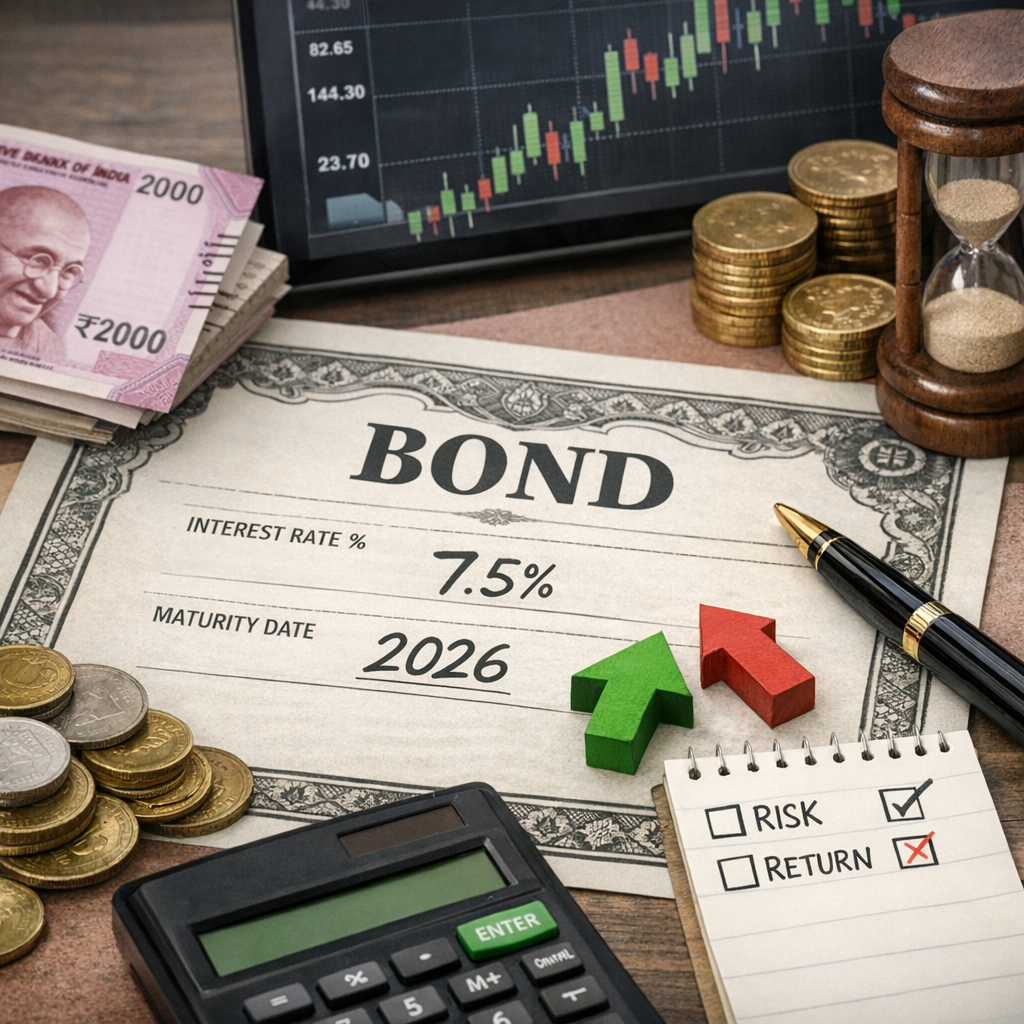
If you have ever lent money to a friend and they promised to pay you back with some extra money as a thank you, you already understand bonds.
Key Takeaways:
- Bonds are loans you give to governments or companies, who pay you regular interest and return your principal at maturity.
- Bond returns come from two sources — coupon (interest) income and capital gains, with Yield to Maturity (YTM) being the best metric to gauge true returns.
- India offers multiple bond types — G-Secs, SDLs, PSU bonds, corporate bonds, and NCDs — each varying in risk and return, with credit ratings guiding safety.
- Key risks include interest rate fluctuations, credit risk, low liquidity, reinvestment uncertainty, and inflation eroding real returns.
- You can buy bonds via RBI Retail Direct (government bonds, zero cost), NSE/BSE through a demat account, or beginner-friendly platforms.
Bonds work the same way. You lend money to the government or a company. They promise to pay you back after a fixed time. And they pay you interest along the way.
That’s it. That’s what bonds are.
But there’s more to the story. How much interest do bonds pay? Can you lose money in bonds? How do you actually buy bonds in India?
This guide answers all these questions.
What Are Bonds?
Bonds are loans you give to governments or companies.
When you buy a bond, you become a lender. The government or company becomes a borrower.
Think of it like this. Your friend needs ₹10,000. You lend them the money. They promise to return ₹10,000 after one year. Plus, they will pay you ₹500 as interest.
Bonds work exactly like this. But instead of your friend, you are lending to:
- The Government of India
- State governments
- Companies like Reliance or Tata
- Public sector companies like NTPC or IRFC
The bond document mentions:
- How much money are you lending? (called face value)
- How much interest will you receive? (called coupon rate)
- When will you get your money back? (called maturity date)
A Simple Example
Let’s say you buy a government bond for ₹1,000.
The bond details say:
- Face value: ₹1,000
- Coupon rate: 7% per year
- Maturity: 5 years
This means:
- You lend ₹1,000 to the government
- Every year, you receive ₹70 as interest (7% of ₹1,000)
- After 5 years, you get your ₹1,000 back
Simple, right?
Why Do Governments and Companies Issue Bonds?
Governments need money to build roads, schools, hospitals, etc. Companies need money to expand factories or launch new products.
They have three ways to get money:
- Take bank loans – But loans can be expensive
- Issue shares – But this means giving up ownership
- Issue bonds – Borrow from many people at once
Bonds allow them to borrow money from thousands of investors at once. This often costs less than bank loans.
For investors, bonds provide a way to earn regular income with relatively lower risk than stocks.
How Do Bond Returns Work?
Bond returns come from two sources.
1. Interest Payments (Coupon Income)
Most bonds pay interest twice a year (semi-annually). This interest is called the coupon.
If a bond has a 7% annual coupon on ₹1,000 face value:
- You receive ₹35 every six months
- Total interest per year: ₹70
Some bonds pay interest quarterly. Some pay annually. The bond document tells you the payment schedule.
2. Capital Gains (Price Changes)
Here is where bonds get interesting.
Bond prices change every day, just like stock prices.
You might buy a bond for ₹1,000. After one year, its price might be ₹1,050. If you sell, you make ₹50 as capital gain.
Or the price might drop to ₹950. If you sell, you lose ₹50.
But here is the key difference from stocks. If you hold the bond until maturity, you always get the face value back. Price changes only matter if you sell before maturity.
Understanding Yield to Maturity (YTM)
YTM tells you the total return if you hold a bond until maturity.
It includes:
- All interest payments you will receive
- Any gain or loss from the difference between what you paid and what you will get back
Simple YTM Example:
You buy a 5-year government bond for ₹950. The face value is ₹1,000. The coupon is 7% per year.
Your returns:
- Interest each year: ₹70
- Gain at maturity: ₹50 (you paid ₹950, get back ₹1,000)
The YTM works out to approximately 8% per year.
The exact calculation is complex. But bond platforms and websites show you the YTM automatically. You don’t need to calculate it yourself.
Key point: Higher YTM means better returns but also higher risk. When comparing bonds, look at the YTM, not just the coupon rate.
Why Do Bond Prices Change?
Two main reasons drive bond price changes.
1. Interest Rate Changes
This is the most important factor.
When interest rates in the economy go up, bond prices fall. When interest rates fall, bond prices rise.
Here’s why. Imagine you bought a bond paying 7% interest. Next month, new bonds start paying 8% interest. Your 7% bond becomes less attractive. Its price falls.
Similarly, if new bonds pay only 6% interest, your 7% bond becomes more valuable. Its price rises.
2. Credit Quality Changes
If a company’s financial health improves, its bond prices rise. If the company faces problems, bond prices fall.
Government bonds rarely face this issue. But corporate bonds do.
Types of Bonds
There are several types of bonds. Each serves a different purpose.
Government Securities (G-Secs)
These are bonds issued by the Government of India.
Key features:
- Safest bonds in India (government guaranteed)
- No risk of default
- Interest rates typically 6-7% per year (At the time of writing this article)
- Tenure ranges from 1 year to 30 years
G-Secs form the backbone of India’s bond market. Banks, insurance companies, and mutual funds hold large amounts of G-Secs.
You can buy G-Secs directly through the Reserve Bank of India (RBI) Retail Direct platform.
Treasury Bills (T-Bills)
T-Bills are short-term government bonds.
Key features:
- Maturity of 91 days, 182 days, or 364 days
- Issued at a discount to face value
- No interest payments during the tenure
- Return comes from the difference between purchase price and face value
Example: You buy a 91-day T-Bill with face value ₹1,000 for ₹980. After 91 days, you receive ₹1,000. Your profit is ₹20.
T-Bills suit investors parking money for short periods.
State Development Loans (SDLs)
State governments issue these bonds.
Key features:
- Similar to G-Secs but issued by state governments
- Slightly higher interest than G-Secs (typically 0.25-0.75% more)
- Slightly higher risk than central government bonds
- Still very safe
SDLs from states like Maharashtra or Gujarat are popular among investors seeking a bit more yield than G-Secs.
Corporate Bonds
Companies issue corporate bonds to raise money.
Key features:
- Higher interest than government bonds
- Interest rates depend on company’s credit rating
- Higher risk than government bonds
- Can be sold on stock exchanges
Corporate bonds are rated by agencies like CRISIL, ICRA, and CARE.
Rating scale:
- AAA: Highest safety
- AA: High safety
- A: Adequate safety
- BBB: Moderate safety
- Below BBB: Higher risk
AAA-rated bonds from companies like HDFC Bank or Reliance offer relatively safe returns 1-2% higher than G-Secs.
Non-Convertible Debentures (NCDs)
NCDs are a type of corporate bond.
Key features:
- Cannot be converted into company shares
- Usually offer higher interest than regular corporate bonds
- Can be secured (backed by assets) or unsecured
- Listed on stock exchanges
Companies like Shriram Finance, Muthoot Finance, and L&T Finance regularly issue NCDs.
Public Sector Undertaking (PSU) Bonds
PSU bonds are issued by government-owned companies.
Key features:
- Issued by companies like NTPC, Power Grid, IRFC, etc.
- Safety between government bonds and corporate bonds
- Interest rates typically 1-1.5% higher than G-Secs
- Popular among conservative investors
PSU bonds from Navaratna and Maharatna PSUs are considered quite safe.
Tax-Free Bonds
Tax-free bonds offer interest that’s exempt from income tax.
Key features:
- Interest income is completely tax-free
- Issued by government entities like NHAI, REC, PFC, etc.
- Long tenure (10-20 years)
- Lower interest rates compared to taxable bonds
Important Note: The government hasn’t issued new tax-free bonds since 2016. Existing bonds trade in the secondary market but availability is limited.
Sovereign Gold Bonds (SGBs)
SGBs are special bonds denominated in grams of gold.
Key features:
- Issued by RBI (issuance discontinued in 2025)
- Pay 2.5% simple interest per year
- Returns linked to gold prices
- Capital gains tax-free if held till maturity
New SGB issuances have stopped. You can only buy existing SGBs on stock exchanges.
Inflation-Indexed Bonds
These bonds adjust for inflation.
Key features:
- Principal and interest linked to inflation
- Protect purchasing power
- Currently not available for retail investors in India
The government first issued these in 1997, reintroduced in 2013 but discontinued and stopped issuing them after 2014.
| Bond Type | Issuer | Typical Interest | Risk Level | Best For |
|---|---|---|---|---|
| G-Secs | Central Government | 6-7.5% | Lowest | Safety-focused investors |
| T-Bills | Central Government | 5.5-6% (annualized) | Lowest | Short-term parking |
| SDLs | State Governments | 7.5-8% | Very Low | Slightly higher returns than G-Secs |
| Corporate Bonds (AAA) | Top Companies | 7-8.5% | Low to Moderate | Better returns with acceptable risk |
| NCDs | Various Companies | 8-10% | Moderate | Higher income seekers |
| PSU Bonds | Govt Companies | 7-8% | Low | Balance of safety and returns |
Source: Recent bond issuances can be tracked on NSE website, BSE website, and RBI Retail Direct platform
Key Risks in Bonds
Bonds are safer than stocks. But they are not risk-free.
Here are the five main risks:
Interest Rate Risk
When interest rates rise, bond prices fall.
If you need to sell your bond before maturity during a period of rising rates, you might get less than what you paid.
Who’s affected?: Investors who might need to sell before maturity.
How to manage?: Hold bonds till maturity or choose short-term bonds if rates are expected to rise.
Credit Risk (Default Risk)
This is the risk that the borrower might not pay back.
Government bonds have almost zero credit risk. Corporate bonds carry higher credit risk, especially those with lower ratings.
Who’s affected?: Corporate bond investors.
How to manage?: Stick to AAA or AA-rated bonds. Diversify across multiple issuers.
Liquidity Risk
Some bonds are hard to sell quickly.
Government bonds have good liquidity. Corporate bonds, especially from smaller companies, can be illiquid.
If you try to sell an illiquid bond urgently, you might have to accept a much lower price.
Who’s affected?: Investors who might need money urgently.
How to manage?: Keep some emergency funds in liquid investments. Choose bonds you can hold till maturity.
Reinvestment Risk
When your bond matures or pays interest, you need to reinvest that money.
If interest rates have fallen by then, you will earn lower returns on the reinvested amount.
Who’s affected?: All bond investors, especially those dependent on interest income.
How to manage?: Use a bond ladder strategy (bonds maturing at different times) to spread reinvestment across different rate environments.
Inflation Risk
If inflation is 6% and your bond pays 7%, your real return is only 1%.
High inflation erodes the purchasing power of your interest income and principal.
Who’s affected?: All bond investors, especially during high inflation periods.
How to manage: Include some inflation-linked investments in your portfolio. Don’t keep all money in bonds.
Taxation of Bonds
Bond taxation depends on whether the bond is listed on a stock exchange.
Listed Bonds
Listed bonds trade on NSE or BSE.
Tax treatment:
- Short-term capital gains (holding less than 1 year): Taxed at your income tax slab rate
- Long-term capital gains (holding more than 1 year): Taxed at 12.5% without indexation benefit
Interest income: Taxed at your income tax slab rate. TDS of 10% applies if interest exceeds ₹5,000 per year from a single issuer.
Unlisted Bonds
Unlisted bonds don’t trade on exchanges.
Tax treatment:
- Short-term capital gains (holding less than 3 years): Taxed at your income tax slab rate
- Long-term capital gains (holding more than 3 years): Taxed at 12.5% without indexation benefit
Interest income: Taxed at your income tax slab rate.
Tax-Free Bonds
Interest from tax-free bonds is exempt from income tax.
But capital gains (if you sell the bond before maturity) are taxable and are taxed at your income tax slab rate.
Sovereign Gold Bonds
Interest is taxed at your slab rate.
Capital gains are tax-free if you hold till maturity. If you sell before maturity on exchanges, capital gains are taxable at your income tax slab rate.
How to Buy Bonds?
You have three main ways to buy bonds:
Method 1: RBI Retail Direct Platform
This is the easiest way to buy government bonds.
RBI launched this platform in 2021 to help individual investors buy G-Secs and T-Bills directly.
Step-by-step process:
Step 1: Visit https://rbiretaildirect.org.in
Step 2: Click on “Register” to create an account.
Step 3: Fill in your details:
- Name
- PAN number
- Bank account details
- Email and mobile number
Step 4: Complete KYC verification. You can do this through Aadhaar-based verification or by uploading documents.
Step 5: Your account gets approved within 1-2 working days.
Step 6: Log in to your account.
Step 7: Navigate to “Primary Issuance” to buy new bonds or “Secondary Market” to buy existing bonds.
Step 8: Select the bond you want to buy. The platform shows:
- Bond name
- Coupon rate
- Maturity date
- Yield (YTM)
- Minimum investment amount
Step 9: Enter the amount you want to invest.
Step 10: Confirm the order. Money gets debited from your linked bank account.
Step 11: Bonds are credited to your RBI Retail Direct account within 1-2 days.
Advantages:
- No charges for buying or selling
- Direct access to government bonds
- Simple interface
- Safe and secure
Limitations:
- Only government bonds available
- No corporate bonds
- Cannot pledge bonds for loans
Method 2: Stock Exchanges (NSE/BSE)
You can buy bonds through stock exchanges just like you buy stocks.
Step-by-step process:
Step 1: You need a demat account and trading account. If you don’t have one, open it with any SEBI-registered broker.
Step 2: Log in to your trading platform (app or website).
Step 3: Go to the “Bonds” or “Debt” section. Different brokers label it differently.
Step 4: Browse available bonds. You will see:
- Government bonds
- Corporate bonds
- NCDs
- SDLs
Step 5: Check the bond details:
- Issuer name
- Credit rating (for corporate bonds)
- Coupon rate
- YTM
- Maturity date
- Minimum lot size
Step 6: Place a buy order. You can place:
- Market order (buy at current price)
- Limit order (buy only if price reaches your specified level)
Step 7: Once the order executes, bonds are credited to your demat account.
Step 8: Interest payments come directly to your linked bank account on due dates.
Advantages:
- Access to government and corporate bonds
- Can buy and sell anytime during market hours
- Prices are transparent
- Settlement happens quickly (T+1 day)
Limitations:
- Brokerage charges apply
- Demat account annual maintenance charges
- Some corporate bonds have large lot sizes (₹1 lakh or more)
Method 3: Bond Platforms
Specialized platforms make buying corporate bonds easier.
Popular platforms include:
- Wint Wealth
- GoldenPi
- The Fixed Income
- Jiraaf
Step-by-step process:
Step 1: Visit the platform’s website or download their app.
Step 2: Sign up with your:
- Mobile number
- PAN number
Step 3: Complete KYC verification by uploading:
- PAN card
- Aadhaar card
- Bank statement or cancelled cheque
Step 4: Link your bank account for payments.
Step 5: Browse bonds available on the platform. You will see:
- Bond details
- Company information
- Credit rating
- Expected returns
- Minimum investment
Step 6: Most platforms allow investments starting from ₹10,000.
Step 7: Select the bond and enter the investment amount.
Step 8: Make payment through net banking or UPI.
Step 9: The platform handles the purchase and demat account creation (if needed).
Step 10: Bonds are credited to your demat account within 2-3 days.
Advantages:
- User-friendly interface
- Lower minimum investment amounts
- Curated bond selection
- Educational content to help you choose
- Customer support
Limitations:
- Platform fees may apply
- Limited bond selection compared to exchanges
- You still need a demat account (platform helps you open one)
Bonds vs Fixed Deposits: A Quick Comparison
Many investors wonder if bonds are better than fixed deposits.
Here is a brief comparison.
Returns:
- FD rates: 6-7.5% for 1-5 years
- G-Sec yields: 6.5-7.5% for similar tenures
- Corporate bonds: 7.5-9% depending on rating
Bonds often offer slightly higher returns than FDs.
Safety:
- FDs are insured up to ₹5 lakh by DICGC
- Government bonds are backed by the government (very safe)
- Corporate bonds depend on company’s credit rating
Government bonds match FD safety. Corporate bonds carry more risk but offer higher returns.
Liquidity:
- FDs: Can withdraw early but with penalty
- Bonds: Can sell anytime on exchanges (if listed)
Listed bonds offer better liquidity than FDs.
Taxation:
- FD interest: Fully taxable at slab rate; TDS applies
- Bond interest: Taxable at slab rate; TDS applies
- Bond capital gains: 12.5% LTCG after holding period
Bonds offer potential tax advantage through capital gains tax rate.
Choice:
- FDs work well for short-term goals and complete safety
- Bonds work well for higher returns and portfolio diversification
You can hold both in your portfolio.
Who Should Invest in Bonds?
Bonds suit several types of investors.
Conservative investors who want regular income with lower risk than stocks.
Retirees who need steady monthly or quarterly income to cover expenses.
Diversification seekers who want to balance their stock-heavy portfolios.
Goal-based investors who have specific needs 3-10 years away and want predictable returns.
Final Thoughts
Bonds provide a middle path between the safety of FDs and the growth potential of stocks.
They pay regular interest. They are generally safer than stocks. And they add stability to your portfolio.
Understanding how bonds work helps you make better investment decisions. You now know:
- What bonds are and how they generate returns?
- The different types of bonds in India
- The key risks to watch for
- How taxation works
- How to actually buy bonds
The Indian bond market is growing. More retail investors are discovering bonds. Platforms like RBI Retail Direct have made access easier than ever.
Start small. Buy one government bond to understand how it works. Track the interest payments. Watch how the price changes.
As you get comfortable, you can explore corporate bonds for higher returns.
Bonds won’t make you rich overnight. But they will help you build wealth steadily. That steady, predictable income is what makes bonds valuable in any portfolio.